And another article published!
This once in the journal Iranian journal WASJ (World Applied Science Journal).
This is the link: www.idosi.org/wasj/wasj14(8)11/21.pdf.
Abstract: Structural dynamics is a rather complex field of research that concerns to a broad range of disciplines, from structural engineering to graphics animation, robotics or aeronautics. A primary consequence of this is an overwhelming amount of literature on the topic, apparently disconnected, as each author focuses on his / her particular field. To complicate things further, the daunting list of numerical methods severely blurs the scope of the researcher, making it very difficult to understand what their purpose is in each case and even if these are applicable to the analysis of structural behavior. This paper presents a reference framework where researchers and developers from diverse disciplines can assess the main methods currently used in structural dynamics simulation. A direct correlation is made between methods to solve Ordinary, Partial and Algebraic Differential Equations and their physical counterparts Time, Matter and Constraints. It is also discussed their application in different industries.
Thanks to my mentors, Jaume and Vojko
lunes, 31 de octubre de 2011

domingo, 9 de octubre de 2011
My first SCI Indexed Article!
Here it is! A whole achievement!
After some while working hard in collaboration with the Faculty of Architecture of the University of Ljubljana the result of our research appears published in a scientific Journal: http://www.ttem-bih.org/ttem_3_2011.html.
As a computational dynamics rookie myself I find it very hard to understand the whole complexity of the topic. For that reason, we decided to make an introductory overview of what is needed to start scouting through such a steepy and accidented path. I hope it serves to somebody else...
As a computational dynamics rookie myself I find it very hard to understand the whole complexity of the topic. For that reason, we decided to make an introductory overview of what is needed to start scouting through such a steepy and accidented path. I hope it serves to somebody else...
However, from all the article my favourite part is at the beginning:
“Structural engineering is the art of molding materials we don’t wholly understand, into shapes we can’t fully analyze, so as to withstand forces we can’t really assess, in such a way that the community at large has no reason to suspect the extent of our ignorance.”Which I found as a quote from James E. Amrhein of the Masonry Institute of America...
Well, happy autumn!
domingo, 25 de septiembre de 2011
First FEM + Lagrange multipliers program in Grasshopper
Good, good...summer is about to finish and here I am, back in Ljubljana!
The last post was created two months ago and a shift in the researching techinques was announced: from C++ under Code:Blocks, Visual Studio or any other IDE (never found the one that fitted my needs), to Visual Basic under Grasshopper...
What a change! It really has boosted productivity...debugging is now as easy as dragging a panel and linking it to a component, results of the changes in the program can be viewed on real time and also with a bit of tweaking its consequences in a CAD model can be represented...wow..absolutely good...
In concrete means, during the summer I have been able to produce the whole Grasshopper definition shown below:

The initial part simply parses data from three files that I chose to be in .txt format, but anyone else could have chosen any other way (i.e. Excel or OpenOffice): Constraints.txt, Nodes.txt and ExternalForces.txt.
The heavy programming components are FEM, LM and LUPD, and I provide their contents here:
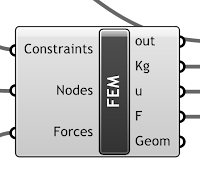


Consistently with the hipothesis that numerical methods for structural can be classifed into Time integrators, Matter Integrators, and Constraint Integrators, I have so far distinguished between LM (Lagrange Multipliers) and FEM (Finite Element Method), remaining for a near future the implemementation of a Newmark-Beta component.
The code provided above simply serves to calculate statics of structures, as the time is yet to be integrated.
I have made the convenient comparisons with a SAP2000 model to verify the exactness of the implementation, with very satisfactory results.
Well...more to come in future editions!
The last post was created two months ago and a shift in the researching techinques was announced: from C++ under Code:Blocks, Visual Studio or any other IDE (never found the one that fitted my needs), to Visual Basic under Grasshopper...
What a change! It really has boosted productivity...debugging is now as easy as dragging a panel and linking it to a component, results of the changes in the program can be viewed on real time and also with a bit of tweaking its consequences in a CAD model can be represented...wow..absolutely good...
In concrete means, during the summer I have been able to produce the whole Grasshopper definition shown below:

The initial part simply parses data from three files that I chose to be in .txt format, but anyone else could have chosen any other way (i.e. Excel or OpenOffice): Constraints.txt, Nodes.txt and ExternalForces.txt.
The heavy programming components are FEM, LM and LUPD, and I provide their contents here:

FEM Component:

LM Component:

LUPD Component:
Consistently with the hipothesis that numerical methods for structural can be classifed into Time integrators, Matter Integrators, and Constraint Integrators, I have so far distinguished between LM (Lagrange Multipliers) and FEM (Finite Element Method), remaining for a near future the implemementation of a Newmark-Beta component.
The code provided above simply serves to calculate statics of structures, as the time is yet to be integrated.
I have made the convenient comparisons with a SAP2000 model to verify the exactness of the implementation, with very satisfactory results.
Well...more to come in future editions!
domingo, 17 de julio de 2011
Programming FEM with Grasshopper(R) for Rhino(R)
In the past year a powerful design tool called Rhinoceros has come into my sphere of activity.
After several attempts of programming the necessary code to experiment with numerical methods using OGRE and C++, I have come to the conclusion that I need some more productive tools. The problem with C++ is that is good for final products and optimized code, but the available libraries for my purposes are normally too specific and complicated, and even simple debugging processes become a nightmare of libraries and strange variables.
Rhinoceros has an IDE plugin called Grasshopper that allows for visually programming with an object-oriented approach, which is very close to what we are intending now.
The next step in the research is to study the differences that appear when combining different methods in order to assess an optimum path for different applications. When studied with object-oriented mind, the numerical methods can easily be composed into GH components that afterwards we just need to link.
One of my main concerns when developing with proprietary non-opensource IDEs and codes comes with the fact that there is always the chance of having to pay fees at some point, not to mention that they are opaque and not always supported by a community willing to help when there is trouble.
However, the case of Grasshopper seems quite strange as there is a strong and dynamic community of researchers and developers also often supported by excellent professionals (at least as far as I have researched, we'll see..).
Well, lets hope I have made the right decision and GH boosts my research results in the near future.
After several attempts of programming the necessary code to experiment with numerical methods using OGRE and C++, I have come to the conclusion that I need some more productive tools. The problem with C++ is that is good for final products and optimized code, but the available libraries for my purposes are normally too specific and complicated, and even simple debugging processes become a nightmare of libraries and strange variables.
Rhinoceros has an IDE plugin called Grasshopper that allows for visually programming with an object-oriented approach, which is very close to what we are intending now.
The next step in the research is to study the differences that appear when combining different methods in order to assess an optimum path for different applications. When studied with object-oriented mind, the numerical methods can easily be composed into GH components that afterwards we just need to link.
 |
| Arrangement of possible components with different integration concepts |
One of my main concerns when developing with proprietary non-opensource IDEs and codes comes with the fact that there is always the chance of having to pay fees at some point, not to mention that they are opaque and not always supported by a community willing to help when there is trouble.
However, the case of Grasshopper seems quite strange as there is a strong and dynamic community of researchers and developers also often supported by excellent professionals (at least as far as I have researched, we'll see..).
Well, lets hope I have made the right decision and GH boosts my research results in the near future.
Suscribirse a:
Entradas (Atom)